Foot reflexology is a firm, structured foot massage. That is the plain description, and we would rather lead with it than with something grander, because an unhurried hour of deliberate pressure through the sole, arch, heel, ankle and lower calf is one of the most reliably pleasant things on our menu. It does not need help from a bigger claim.
At May Breeze Spa it is $50 for 30 minutes and $70 for the hour, seven days a week on Plymouth Rd. Shoes and socks come off; everything else stays on. You sit in a reclining chair rather than lying on a table, which is why this tends to be where people start if they have never booked bodywork before.
What a Foot Reflexology Session Actually Involves
The work is thumb and knuckle pressure applied point by point, rather than the long gliding strokes of a Swedish massage. The therapist moves through the sole in sections, takes the pad under each toe, works the arch and the heel, then opens out into the ankle and the lower calf. The calf matters more than people expect — most of the muscle that moves your foot lives up there, not in the foot itself.
Pressure is firm, and usually firmer than first-timers anticipate. The arch and the outside of the heel are where most people discover they are more tender than they thought. Say so. "Lighter" takes effect immediately and costs you nothing, and there is no version of this where gritting your teeth for forty minutes produces a better result.
What Happens in the Reflexology Room
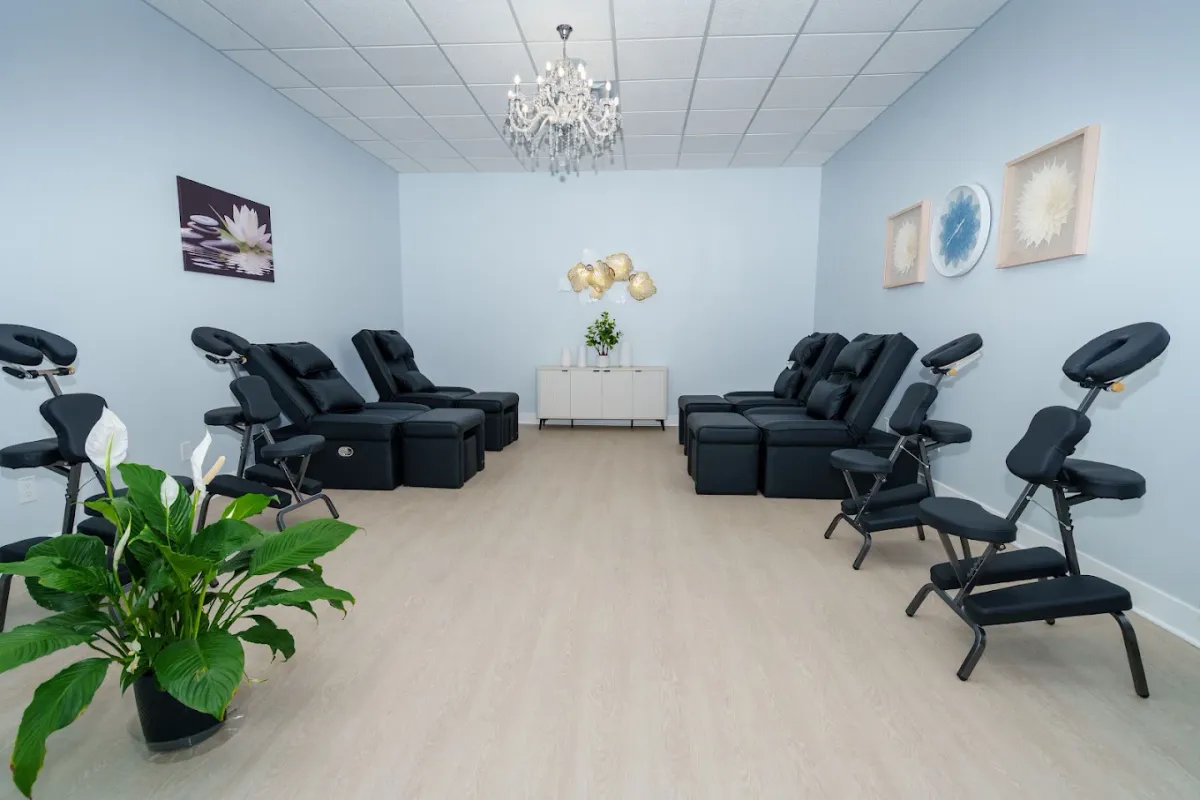
The reflexology room has reclining chairs, not massage tables — pale blue-green walls, a chandelier, and enough space between chairs that two people can book together and still talk or not talk as they prefer. The chair goes back far enough that a fair number of guests fall asleep in it. A warm towel over the feet at the start, a hot towel to finish.
Because nothing has to be draped or undressed, the session starts fast. Two minutes of conversation about pressure and anywhere to avoid — a healing blister, an ankle you rolled in March, a toe you would rather nobody touched — and then it begins.
The Foot-to-Organ Map, and Why We Do Not Claim It
Reflexology arrives with a theory attached. The traditional chart divides the foot into zones said to correspond to organs and systems elsewhere in the body: a patch under the ball of the foot for the lungs, a band down the inner arch for the spine, a point on the sole for the liver. Working the zone is supposed to do something for the organ.
There is no good evidence for that mapping. It is an old and internally consistent idea, and it is genuinely interesting as history — but the claim that pressing a particular square centimetre of your sole reaches an organ has not held up when people have tried to test it. We are not going to print it on a page and take $70 off you on the strength of it.
What remains once you set the chart aside is not nothing. It is a well-delivered hour of firm pressure on the part of the body that carries your entire weight all day and almost never gets touched. The relaxation is real, and it is measurable in ordinary ways.
Read the second half of that as carefully as the first. Measurable drops in anxiety, blood pressure and heart rate; no change in cortisol. That null result is what quietly disposes of the "flushes out toxins" and "releases stored stress hormones" language you will find on a lot of reflexology pages. Same goes for circulation: your feet will feel warm and loose afterwards, which is genuinely nice, and we are not going to translate that into a claim about your cardiovascular system.
Who Books a Foot Massage in Livonia
The bookings sort into two groups. The larger one is people who are on their feet for a living and have stopped noticing what it costs them until somebody presses on it.
- Nurses and techs coming off a twelve-hour shift, where the ache sits in the arch and the heel rather than the toes.
- Retail and restaurant staff — concrete floors, ten thousand steps a shift, and shoes chosen for a dress code rather than for feet.
- Teachers and stylists, who stand largely in one place, which is harder on feet than walking is.
- Anyone back from a lot of walking: a trip, a conference, two days at a wedding in shoes that turned out to be a mistake.
- People who want bodywork but do not want to undress for it. This is the whole service for that, not a stripped-down version of a real one.
The second group books it as the low-commitment option — a first time in a spa, a gift for a parent, or a couple where one person wants a full massage and the other honestly does not. Thirty minutes at $50 is small enough to be an easy yes.
Thirty Minutes, an Hour, or the Reflexology & Back Massage
Thirty minutes at $50 covers both feet properly and nothing else. It is a real session rather than a taster, but it moves — fifteen minutes a side means the therapist is not lingering anywhere.
The hour at $70 is what to book if the feet are the actual problem. What it buys is slowness: the same route at half the pace, with real time for the ankle and calf that the short session has to hurry past.
Around Livonia you will see reflexology advertised at about $65 an hour, and we are $70. Rather than pretend five dollars is nothing, here is what it is for. Our hour is sixty minutes of hands on your feet, in a room built for this with proper recliners, with the greeting, the intake and the settling in happening outside the clock. If you find that same hour elsewhere for $65, take it — we would rather you had a good hour than a loyal one.
Reflexology & Back Massage — the Best Value on the Menu
Two combination sessions pair the feet with back work, and the pricing is the whole argument. Sixty minutes is $70 — thirty on the feet, thirty on the back — which is exactly what a straight hour of reflexology costs. Ninety minutes is $110: thirty on the feet, then a full hour on the back, neck and shoulders, which is exactly what a straight 90-minute massage costs.
So you are not paying a premium for the variety. If you are stuck choosing between an hour of feet and an hour of back, the $70 combination removes the question. The $110 version is the most treatment we can fit into a single appointment under two hours, and it is the one to book if you come in once a month and want that visit to count. Both run feet first, then the back — that is the order on the menu.
Is Reflexology Safe?
Low risk, with the ordinary caveats. Tell us about recent foot or ankle injuries, diabetes or any numbness in the feet, blood clots, broken skin, or a pregnancy, and we will adapt the session or occasionally suggest you check with your doctor first.
One line worth adding for feet specifically: this is not a treatment for plantar fasciitis, heel spurs, or nerve pain. If your feet hurt in a way that is sharp, new, numb, or getting worse, that is a question for a podiatrist rather than a spa.
Book foot reflexology on Plymouth Rd
-
Foot Reflexology
30 minutes $5060 minutes $70 -
Foot Reflexology Combination — 30 mins Foot Massage + 30 mins Back Massage
30 min foot + 30 min back $70 -
Foot Reflexology Combination — 30 mins Foot Massage + 60 mins Back Massage
30 min foot + 60 min back $120
May Breeze Spa is at 34722 Plymouth Rd, Livonia, MI 48150, open 10 AM to 8 PM Monday through Saturday and 10 AM to 6 PM on Sunday. Booking is online. If you are coming straight off a shift, say so when you arrive — it changes where the therapist spends the time.
Sources
- AMTA — Massage Can Improve Health and Wellness
- NCCIH — Things To Know About Massage Therapy for Health Purposes
- NCCIH — Massage Therapy: What You Need To Know
This page is general wellness information, not medical advice. Massage and facial treatments at May Breeze Spa are cosmetic and relaxation services — they do not diagnose or treat any medical condition. New or severe pain, numbness, weakness, or a recent injury deserves a clinician, not a spa booking.